


In my workshops, I map out 7 pathways that empower people to pursue the practice of Personal Mastery.
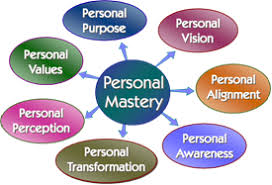
The first 3 – purpose, vision and values– constitute essential cornerstones:
1. Personal Vision.
Many leaders have goals but far fewer have a real sense of personal vision: an ability to picture clearly the best leader we can be and work towards that with focus, determination and diligence. Personal vision provides energy and impetus to change. It’s like a point on the horizon you set to guide the path you take. Without it, you wonder around aimlessly.
“Your vision will become clear only when you can look into your own heart. Who looks outside, dreams; who looks inside, awakes.”– Carl Jung
2. Personal Purpose
In many ways Personal Purpose precedes Personal Vision. We all crave meaning in our lives. We want to feel that our lives matter and know how we make a difference, what our special gifts, talents and contributions are and why we do what we do. Purpose fuels passion. It’s energising.
“The simplest definition of personal purpose: theextent to which one can create one’s life the way heor she would like it to be.”– Peter Senge
3. Personal Values
The things that matter most to us form the foundation for personal vision. Leaders who practise Personal Mastery are guided by, and driven to act out of, a clear set of values in all areas of their lives. Being clear on values you consciously choose to hold – and changing them if they do not match – is at the heart of attributes like integrity and authenticity.
The other 4 pathways can be viewed as skill development sets that enable you to realise your personal purpose and vision and help you live your values.
4. Personal Alignment
This is the degree to which our personal vision, purpose, values and behaviours are congruent with each other. When these things match-up closely, huge amounts of positive power and energy can be unleashed, and we find the creative capacity to re-shape and re-new ourselves. Leaders who are out-of-touch or out-of-sync with these, often pursue courses of action that create inner-conflict; delimit their power or potential and lead them to adopt adverse behaviours.
5. Personal Perception
Simply put, this is being aware of the particular ways you tend to perceive things – the frames of reference you use to see other people, events and situations. It’s also about your ‘self-identity’ and ‘self-concept’, which is the source of your ‘self-esteem’ and the degree to which you learn to perceive yourself accurately.
As we focus outwards, another question comes into focus: “Is how I see myself and what I stand for the same as how others see me?”
This relates to how accurately leaders see themselves, which also extends to how you see other people, events and situations too. Our way of seeing impacts our way of being which links to personal awareness.
6. Personal Awareness
Personal awareness is how much you know (or are willing to know) about yourself – what makes you the way you are, your wants, drives,needs, desires and preferences. It’s being able to step back and become an observer of what you’re really like: your patterns of thinking, feeling and behaving; seeing how those patterns impact on others and affect the quality of your interactions; strengthening those that get you good results and changing those that don’t.
What we’re not aware of often controls us. Without knowing themselves, leaders can’t help teams to develop skills to think and work better together, engender a sense of purpose or build positive emotional climates. They also remain unaware of the personal patterns shaping their thoughts, emotions, actions and approaches to challenging situations. They blame others and rarely look at their contribution.
“Wisdom tends to grow in proportion to one’s awareness of one’s ignorance.”– Anthony de Mello
7. Personal Transformation
Not in so many words, this is the creative capacity we all have to re-shape, re-new or reinvent ourselves to be more in harmony with our personal vision, values and purpose. The ability to bridge those unavoidable gaps between personal vision and present reality is a key action-element of Personal Mastery.
“Every success story is a tale of constant adaption, revision and change.” –RichardBranson